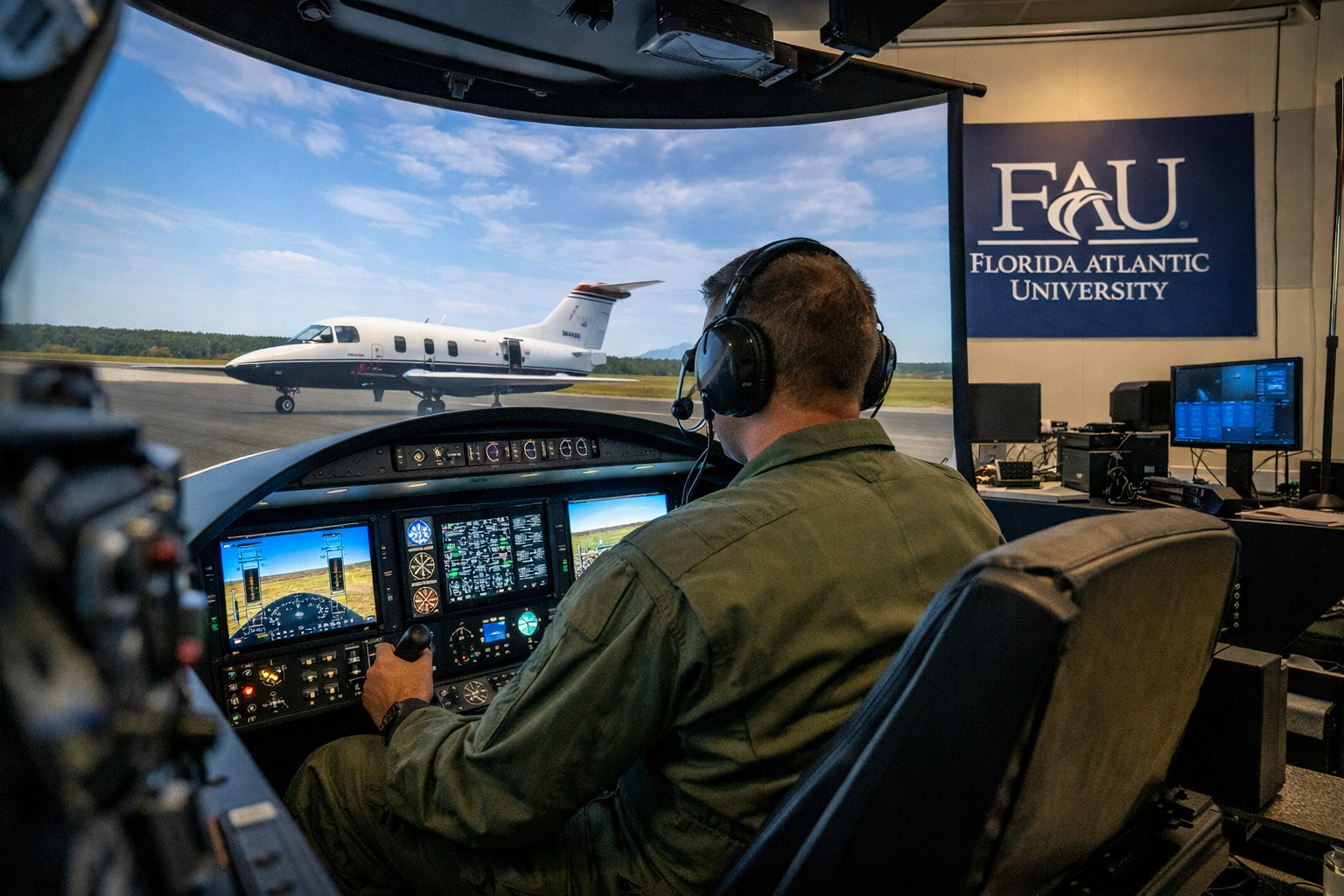
The Jayhawk flight simulator is now operational at Florida Atlantic University following a $4.5 million in-kind grant from the U.S. Air Force Office of Scientific Research. The mixed-reality system replicates the T-1A Jayhawk training aircraft and will support advanced aerospace research, pilot training development and multidisciplinary engineering projects.
The simulator is housed within FAU’s College of Engineering and Computer Science and is designed to mirror the cockpit layout, flight dynamics and operational systems of the twin-engine T-1A platform used for advanced U.S. Air Force pilot instruction.
A High-Fidelity Mixed-Reality Training Environment
The Jayhawk flight simulator features a full cockpit replica paired with a 3D motion platform and immersive visualization systems. Its open-architecture software allows researchers to integrate artificial intelligence models, autonomy frameworks and advanced sensor systems into realistic flight scenarios.
Faculty and students can safely simulate high-risk operational environments that would be impractical or unsafe to recreate in live aircraft. The platform supports experimentation in autonomous systems, adaptive flight controls and human-machine interaction.
Jayhawk Flight Simulator: Expanding Aerospace and Cross-Disciplinary Research
University officials say the simulator will function as both a training tool and a research platform. Beyond aerospace engineering, the system is expected to contribute to work in neuroscience, human performance analysis, cybersecurity and systems engineering.
By allowing researchers to measure cognitive workload and pilot response in controlled yet immersive conditions, the simulator opens new pathways for studying human performance under stress.
Strengthening Federal and Industry Partnerships
The installation of the Jayhawk flight simulator positions FAU to expand collaboration with federal agencies and aerospace industry partners. The system is expected to play a key role in attracting research funding and preparing students for careers in aviation technology, defense systems and intelligent systems design.
The simulator is now available for research integration and academic use within the university’s engineering programs.